
Jagadguru Kripalu Ji Maharaj
In the last 2500 years, there were only four Jagadgurus. After the first in the last 700 years, the fifth Jagadguru title was given to Shree Kripaluji Maharaj in 1957 A.D., at the age of 34.
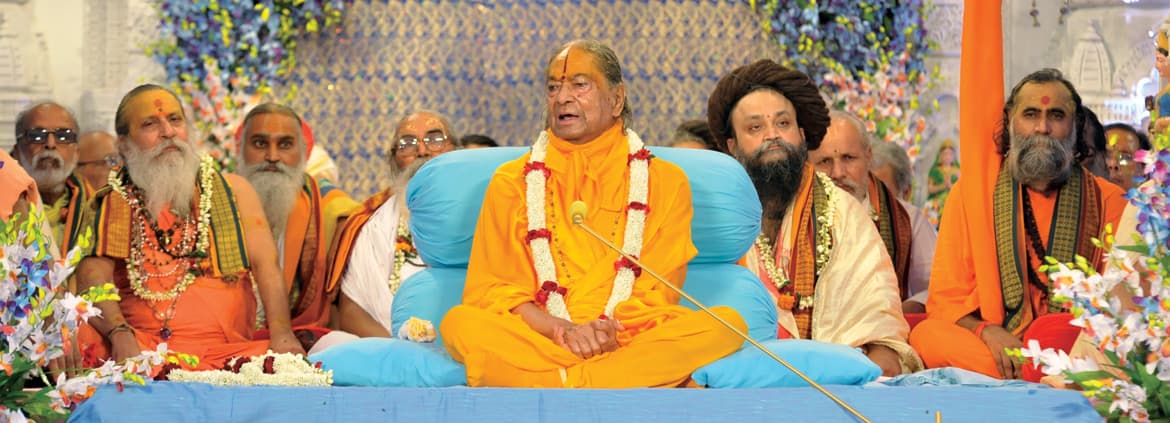
In the last 2500 years, there were only four Jagadgurus: Jagadguru Shree Nimbarakacharya, Jagadguru Shree Sankharacharya, Jagadguru Shree Ramanujacharya, and Jagadguru Shree Madhavacharya. Then, after the first in the last 700 years, the Fifth Jagadguru title was given to Shree Kripaluji Maharaj in the year 1957 A.D. on January 14, at the young age of 34.
Jagadguru Shree Kripalu Ji Maharaj appeared on this earth at midnight, on the full moon (Poornima) in October 1922 A.D., as Ram Kripalu Tripathi in Mangarh, near Allahabad, India. Sharad Poornima is extremely auspicious for the devotees of Krishna, because it was on this full moon night of October, five thousand years ago, that their beloved Lord revealed the glory of selfless Divine love to the world by performing the Divine Dance, Maharaas, with the Gopis.
Jagadguru Shree Kripalu Ji Maharaj received his preliminary education in Hindi and Sanskrit in the local school, going on to study advanced Sanskrit and Ayurved in Indore and Varanasi, and spending a year or more around Chitrakoot. After completing his formal education at the age of 16, he entered self-imposed Banbas. He found his way to Vrindavan, and the next year emerged as a Guru known affectionately as Shree MaharajJi.
In 1955 A.D., Jagadguru Shree Kripaluji Maharaj organized a religious convention in which prominent spiritual leaders of India gathered, including Mahamahopadhyay Giridhar Sharma, President of the Kashi Vidvat Parishad, who was impressed by Shree Kripaluji Maharaj’s learning and scriptural knowledge. At another convention in Kanpur in 1956 A.D., Shree Raj Narain, Shat Shastree and Chief Secretary of the Kashi Vidvat Parishad, heard Kripaluji Maharaj’s discourses and, after returning to Kashi, invited him to give a spiritual discourse to the scholars there in 1957 A.D. His speeches lasted seven days, after which he was formally installed as the Fifth Jagadguru by the Kashi Vidvat Parishad — a body of 500 of India’s foremost scriptural scholars, the oldest and most recognized of Varanasi’s intellectuals. In full agreement with one another, all 500 scholars offered him not the title of Jagadguru but Jagadguru Uttam — the greatest of all Jagadgurus. The Kashi Vidvat Parishad also conferred on him the titles Bhaktiyog-Ras-Avtar and Nikhildarshansamanvayacharya, the supreme Acharya who reconciled the philosophies of all the Darshan Shastras.
According to Jagadguru Shree Kripaluji Maharaj, “the desired goal of the soul is to attain the Selfless Divine love of Radha Krishna, who are eternally related to you.” He teaches that Radha Krishna are the supreme form of God and of Divine Love, and are eternally related to us. He accepts the Shat Sandarbh of Jeev Goswami and teaches that the Bhagwatam is the true explanation of the Upanishads and Brahma Sutras, reconciling the differences that appeared in the philosophies of the other Jagadgurus and Darshan Shastras. He is quoted as saying, “The Bhakta has only to surrender himself and do nothing else, but he has to do a lot for doing nothing.” He has published many spiritual books for devotees, and many temples, schools, colleges, and hospitals have been constructed under his observation.
Published books
Perm Ras Siddhant
The philosophy of Divine love, first published in Hindi in 1955 and later in English, Nepali, Telugu, Bengali, Odia, and other languages.
Bhakti Shatak
The concise philosophy of the Upanishads, Gita, Brahma Sutra, and the Bhagwatam in an easy-to-understand style, published in English, Nepali, Hindi, and other languages.
Radha Govind Geet
Printed in two volumes, with eleven thousand one hundred and eleven couplets of Radha Krishna leelas and devotional philosophy, published only in Hindi.
Prem Ras Madira
1008 songs (pad) of Radha Krishna leelas, devotional philosophy, and humbleness, first published in Hindi and later in Nepali, Odia, and other languages.
Yugal Shatak
One hundred kirtans of Radha Rani and Krishna.
Yugal Ras
Kirtans of Radha Krishna.
Shree Krishna Dwadashi and Shree Radha Trayodashi
Twelve pads describing the beauty and decorations of Krishna, and thirteen pads about the beauty and decorations of Radha Rani.